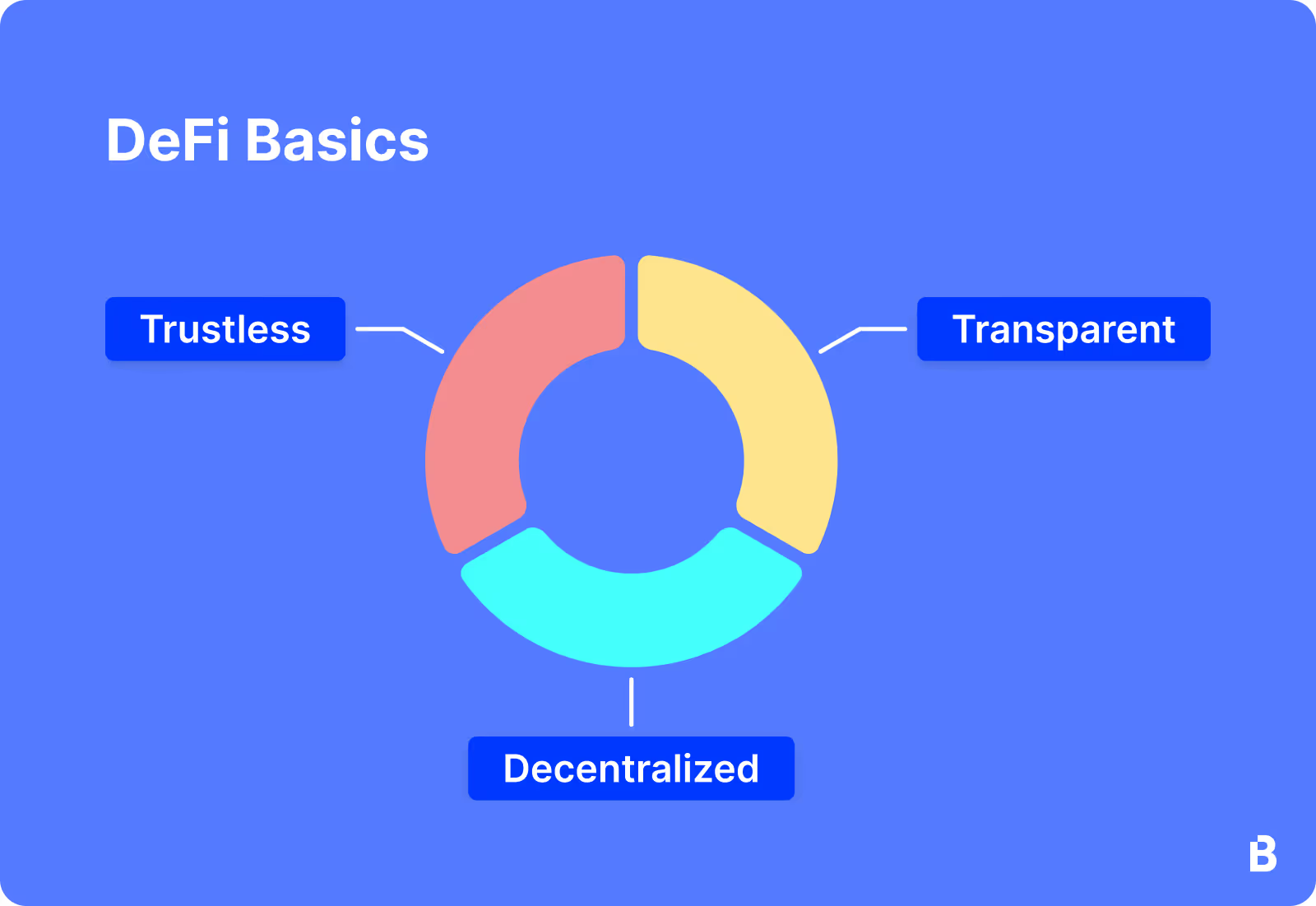
Decentralized finance, commonly known as DeFi, represents a seismic shift in the world of finance, promising to democratize access to financial services and dismantle traditional banking barriers. Operating predominantly on blockchain platforms, DeFi applications offer a range of services—from lending and borrowing to asset trading—without the need for intermediaries like banks or financial institutions.
But how does this burgeoning ecosystem function, and what sets it apart from the conventional financial system? This article will introduce you to the foundational concepts of DeFi, exploring its mechanisms, advantages, and the transformative potential it holds for the financial landscape.
The evolution of finance: From traditional to decentralized
The realm of finance has continually evolved, mirroring society’s advancements and technological leaps. For decades, traditional finance, often termed as ‘CeFi’ (Centralized Finance), has been the backbone of global economies with centralized institutions like banks, brokerages, and insurance companies playing pivotal roles.
Decentralized Finance (DeFi), in contrast, removes these intermediaries, operating instead on computer code within blockchain platforms.
With DeFi, all transactions and agreements are dictated by algorithms and smart contracts. This system ensures rigorous conditions for financial activities; for example, there are precise scenarios in which a borrower’s collateral is liquidated in DeFi platforms.
These safeguards minimize risks like bad debt and human error. So, while CeFi operates on trust in institutions, DeFi shifts this trust to its code and foundational technology.
Understanding the value proposition: Why DeFi?
DeFi democratizes financial access, removing intermediaries and thereby lowering costs and barriers. Individuals gain complete autonomy over their assets, addressing gaps left by traditional banks.
With DeFi’s blockchain foundation, transactions that once took days now conclude in mere minutes, an essential edge in dynamic financial markets.
Beyond speed, DeFi revolutionizes investment through tokenization. Real-world assets, from real estate to art, are represented as tradeable blockchain tokens, democratizing investments and boosting liquidity in traditionally stagnant markets.
In short, with its rapid transactions and diverse investment avenues, DeFi presents a transformative alternative to conventional finance.
Decentralization: Power to the people
Decentralization ensures no single entity dominates. In DeFi, it’s the community or network participants that wield power, fostering security and democratizing decision-making.
With smart contracts, DeFi products can incorporate democratic elements, enabling collective decisions on governance, product modifications, or distribution by token holders. This democratic approach makes users active stakeholders, not just passive consumers.
By melding blockchain with democratic governance, DeFi promises a transparent, inclusive, and responsive financial ecosystem.
Trustless systems and peer-to-peer transactions
DeFi’s hallmark is ‘trustless’ transactions, where parties transact without needing mutual trust, guaranteed by blockchain. This trustlessness is vital not only for human transactions but also for machine-to-machine interactions.
As our world leans more into the Internet of Things (IoT) and autonomous systems, machines will frequently transact amongst themselves, requiring immediate and transparent trustless transactions.
DeFi facilitates this, paving the way for an era where machines act as both consumers and service providers.
Public and Transparent Ledger: Blockchain’s Role
Blockchain serves as DeFi’s public and transparent ledger, allowing anyone to audit or verify transactions, enhancing fairness and trust. Underpinning these DeFi fundamentals – decentralization, trustless transactions, and transparent blockchain – are smart contracts.
These self-executing contracts embed agreement terms into code lines. In DeFi, smart contracts automate financial arrangements, ensuring adherence to set rules without middlemen, solidifying DeFi’s stance as a significant financial disruptor.
Core Components of DeFi
Stablecoins: Bridging traditional currency and crypto
Stablecoins aim to mirror the value of traditional currencies, providing a stable medium of exchange and a unit of measure in the otherwise volatile crypto market. The pegging to traditional currencies can be achieved through various means, and understanding these mechanisms helps in assessing the stability and risk associated with each type:
Cash or cash equivalents stablecoins
These stablecoins anchor their value by maintaining reserves of traditional fiat currency or cash equivalents. For every stablecoin minted, there’s a corresponding value held as collateral in these assets. Regular audits ensure transparency. Such stablecoins incorporate not just fiat but also assets like low-risk government securities, such as Treasury Bills, reinforcing their stability and trustworthiness in the market.
Examples are USDC and Tether (USDT)
Crypto-collateralized stablecoins
These stablecoins are over-collateralized by other cryptocurrencies, like Ether. If the collateral’s value drops, the smart contract liquidates enough collateral to ensure the stablecoin’s peg remains intact.
Example: DAI uses over-collateralized assets like Ether.
Basket-collateralized stablecoins
Instead of being pegged to a single currency or asset, these stablecoins are pegged to a basket of assets. The basket can comprise various fiat currencies, commodities, or other assets, diversifying the collateral and potentially reducing volatility and risk.
Example: Libra (now known as Diem) initially proposed a model where its value would be pegged to a basket of international fiat currencies and short-term government securities.
Algorithmic stablecoins
These stablecoins use algorithms and smart contracts to automatically adjust the supply based on demand, keeping the price stable without any backing collateral.
Example: Terra’s (LUNA) stablecoin UST was the most prominent example
Decentralized exchanges (DEX)
Unlike centralized exchanges that act as intermediaries, DEXs allow peer-to-peer trades.
How they work: Automated market makers (AMMs)
Automated market makers (AMMs) represent a revolutionary approach to digital asset trading, a departure from traditional finance and its reliance on order books. In traditional exchanges, buyers and sellers place orders at different prices, and trades are executed when there’s a match. AMMs, however, use a mathematical formula to set the price of an asset, enabling instant trades without the need for a counterparty.
At the heart of AMMs are liquidity pools. Instead of matching buyers and sellers, users trade against these pools. Anyone can become a liquidity provider by depositing their assets into these pools, and in return, they receive liquidity tokens. These tokens can later be redeemed for their share of the pooled assets, plus a portion of the trading fees.
Benefits:
- Permissionless: Anyone can create a market by providing liquidity.
- Constant liquidity: Unlike order book-based exchanges, as long as there’s some liquidity, trades can happen.
- Reduced slippage: With enough liquidity, AMMs can offer comparable, if not better, rates to traditional exchanges.